
LONDRES.- Nació sin tobillos ni peronés. Pero para él eso no fue nunca un obstáculo. El sudafricano Oscar Pistorius (Pretoria, 1986) gozó desde niño de un sexto sentido para el deporte. Y practicó un buen puñado de ellos. Primero el rugby y el waterpolo, más tarde la natación, por último –de momento– el atletismo.
Allá donde fue le acompañaron una voluntad de hierro, un insaciable espíritu competitivo y dos prótesis con las que engañar a la naturaleza. Pisando sobre ellas, alcanzó la cima de la velocidad en los Juegos Paralímpicos de Atenas, en 2004, con un oro en los 200 metros y un bronce en la carrera de 100.
No contento con ello ha pulverizado desde entonces los récords mundiales paralímpicos de 100, 200 y 400 metros y ha llamado a las puertas de la Federación Internacional de Atletismo (IAAF) con la intención de ser el primer atleta sin piernas en competir contra atletas de elite.
Al principio la IAAF se negaba en redondo, con el argumento de que las prótesis otorgan a Pistorius una ventaja suplementaria sobre sus rivales. De un tiempo a esta parte, sin embargo, ha matizado su postura y se ha comprometido a estudiar en profundidad el caso.
Pistorius correrá los 400 metros en la Golden Gala de Roma y repetirá distancia el domingo en el Grand Prix de Sheffield, donde compartirá cartel nada menos que con el campeón olímpico y mundial, Jeremy Wariner, y con el campeón de la Commonwealth, el australiano John Steffensen. La IAAF aprovechará las dos citas para mirar con lupa sus movimientos antes de decidir definitivamente si le da acceso o no a competiciones oficiales.
Dos son las que Pistorius tiene entre ceja y ceja: los Mundiales de este año en Osaka o los Juegos Olímpicos de Pekín 2008, su sueño dorado. Su marca actual (46.56) está a apenas tres segundos del récord mundial y a sólo dos de la marca de la final de Atenas, pero aun así sigue por encima de la mínima exigida para ir a Osaka. Esto no impediría, sin embargo, que el sudafricano se colara en el equipo sudafricano de 4 por 400, lo que le abriría una puerta lateral a la prueba.
Ventajas y desventajas
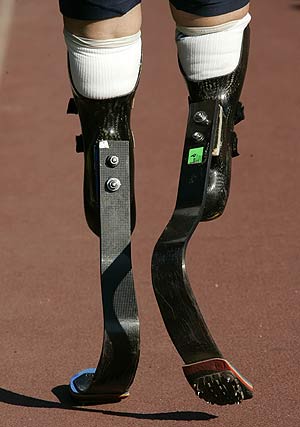
Detalle de las prótesis. (Foto: REUTERS)
Las razones por las que la IAAF no da su brazo a torcer son muy diversas. Hay quien dice que las suelas de las prótesis le proporcionan una amortiguación mejor que la de las zapatillas normales o que le dan una ventaja especial en los últimos metros. Sin embargo, no es menos cierto que sobre una pista mojada Pistorius corre más riesgos que los demás atletas. No sólo porque se agarran muy poco al tartán. También porque, si se fuera al suelo, se haría más daño que sus competidores por la dificultad añadida de suavizar la caída sólo con las manos. Las prótesis que han dado fama a Pistorius son conocidas como cheetahs y las fabrica una firma especial en Islandia. Cada par cuesta más de 20.000 euros.
Oscar Pistorius no nació sin piernas. Se las amputaron cuando tenía sólo 11 meses. El hombre que lo hizo, el doctor Gerry Versveld, estaba en el Estadio Olímpico de Atenas el día que ganó el oro olímpico. "Gracias, nunca podré ver nada más sorprendente que esto", le dijo entonces. Versveld le cortó las piernas, pero la decisión la tomaron sus padres.
Ellos –atribulados antes y después de la operación por los dolores del niño– lo hicieron aconsejados por los especialistas, que no veían salida a aquellas extremidades que habían salido del útero materno sin peronés ni tobillos. Y lo hicieron sólo después de una visión reveladora: la de un joven amputado que jugaba al tenis, corría y nadaba en la escuela. Un Pistorius precoz antes de Pistorius.
Al principio las cosas fueron muy bien. En sólo seis meses, el pequeño Oscar correteaba de un lugar a otro con sus pequeñas prótesis. Luego la cosa se complicó. Vinieron el colegio y los niños mofándose. Los gamberros se cebaban en el lisiado y éste se zafaba como podía de sus burlas. A él, como a tantos otros, le salvó el deporte. Primero el rugby, que le hizo popular en el instituto y que tuvo que abandonar tras una lesión de rodilla. Luego el atletismo, descubierto hace sólo cuatro años.
"Yo no soy un inválido, simplemente no tengo piernas", suele decir en las entrevistas, tratando de ablandar el corazón de los 'supertacañones' de la IAAF, conminados a decidir sobre su complicado caso. Le apodan el atleta biónico o blade-runner, haciendo un juego de palabras con la nomenclatura inglesa de sus prótesis ('blade').
Dicen que Tom Hanks trabaja ya en un guión sobre su historia, termine o no sobre el tartán olímpico. La madre de Oscar Pistorius murió inesperadamente hace cuatro años. No pudo disfrutar del éxito de su hijo. Sin embargo, cuando él tenía apenas un año le escribió una carta para cuando fuera mayor que decía: "Un perdedor no es quien llega el último sino aquél que se sienta y mira y nunca ha intentado correr".
Accompanied him wherever he was an iron will and an insatiable competitive spirit with which two prosthetic deceiving nature. Stepping on them, reached the top of the speed in the Paralympic Games in Athens in 2004 with a gold in the 200 meters and a bronze in the 100.
Not content with this spray has since then paralympic world records at 100, 200 and 400 meters and has called on the doorstep of the International Athletics Federation (IAAF) with the intention of being the first athlete with no legs in elite athletes compete against .
At first round IAAF refused, arguing that the prosthetics give Pistorius an additional advantage over their opponents. For some time now, however, has tempered his stance and has pledged to scrutinize the case.
Pistorius will run the 400 meters at the Golden Gala in Rome on Sunday and repeat distance at the Grand Prix in Sheffield, where he shared cartel with nothing less than world and Olympic champion, Jeremy Wariner, and the champion of the Commonwealth, the Australian John Steffensen. The IAAF will use the two events to watch his movements very carefully before deciding definitively whether or not given access to official competitions.
There are two that Pistorius is between eyebrow and eyebrow: the World Cup this year in Osaka and Beijing 2008 Olympics, his golden dream. His current mark (46.56) is just three seconds the world record and just two of the final mark of Athens, but still remains above the minimum required to go to Osaka. This would not preclude, however, that the South African colara in the South African team of 4 for 400, which would open a side door to the test.
Advantages and disadvantages
Details of the prostheses. (Photo: REUTERS)
Details of the prostheses. (Photo: REUTERS)
The reason why the IAAF does not twist his arm to vary widely. Some say that the soles of the prosthesis will provide a better buffer than the normal or shoes that give a special advantage in the final meters. However, the fact remains that on a wet track Pistorius runs more risk than other athletes. Not only because it holds very little tartan. Also because, if you were to ground, which would further harm its competitors by the difficulty of relaxing the fall with your hands only. Prostheses that have given fame to Pistorius Cheetahs are known to produce a signature and Iceland in particular. Each pair costs more than 20,000 euros.
Oscar Pistorius was not born without legs. They were amputated when he was only 11 months. The man who did, Dr. Gerry Versveld, was in the Olympic Stadium in Athens on the day he won the Olympic gold. "Thank you, I can never see anything more amazing that," he said then. Versveld cut legs, but the decision was taken by his parents.
Troubled them before and after the operation the pain of child-were advised by the specialist that they saw no way out of those limbs that had left the womb without a fibula or ankle. They did so only after a revelatory vision: that of a young amputee who was playing tennis, running and swimming in the school. An early before Pistorius Pistorius.
At first things went well. In just six months, the little Oscar run from one place to another with small prosthesis. Then things became complicated. Then came college and children flout. The hooligans were crippled in cebaban and it could zafaba as their taunts. He, like many others, he saved the sport. First the rugby, which made him popular in high school and had to leave after a knee injury. Then athletics, discovered only four years ago.
"I'm not a cripple, just do not have legs," often said in interviews, trying to soften the hearts of the 'supertacañones' from the IAAF, ordered to make decisions about their complicated case. He nicknamed the bionic athlete or blade-runner, making a pun with the nomenclature of English prosthesis ( 'blade').
They say that Tom Hanks is already working on a screenplay about their history, finished or not on the Olympic tartan. Oscar Pistorius's mother died unexpectedly four years ago. He could not enjoy the success of his son. However, when he was barely a year he wrote a longer letter when saying: "A loser is not who comes the last but one who sits and watches and has never tried to run."


No hay comentarios:
Publicar un comentario